
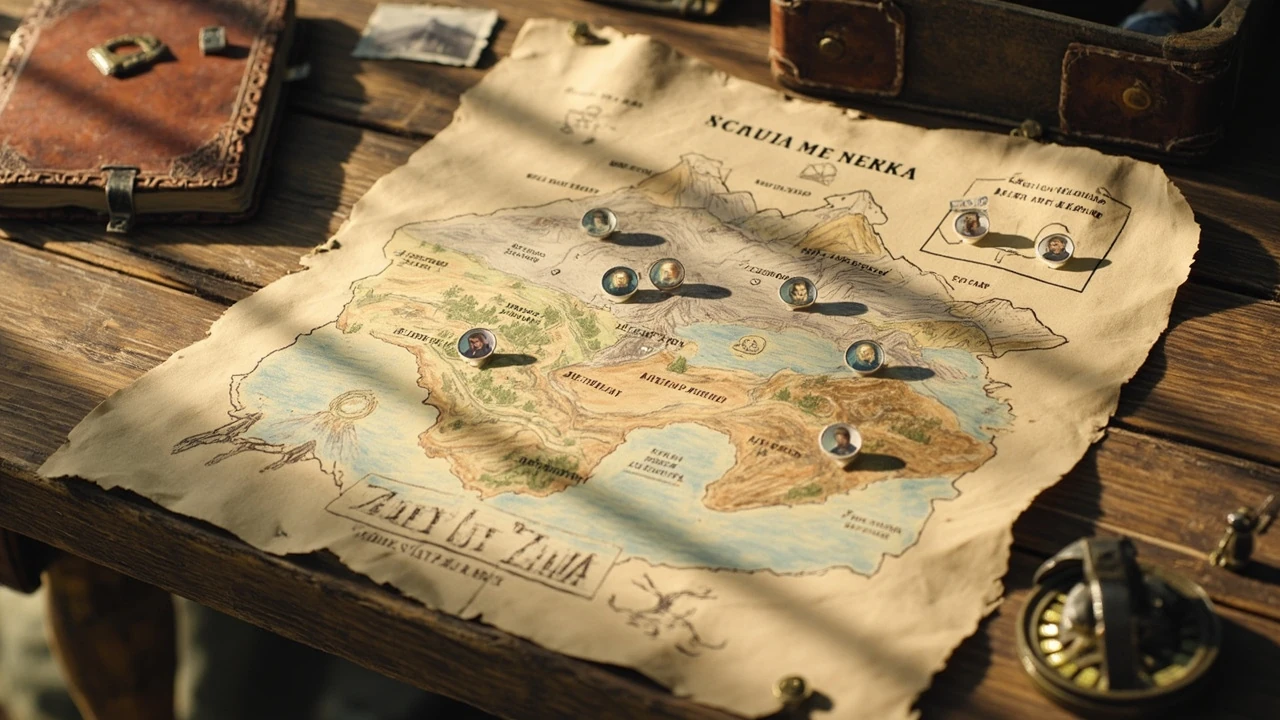
Memory locations in BOTW: what the system actually does
Memory locations in BOTW are eighteen fixed spots on the Hyrule map where Link recovers a piece of his past through a flashback cutscene. Each location hands back one specific photograph that Pikango, the Sheikah painter who waits at the tech labs and a few stables, is happy to describe, and viewing the recovered scene in the quest log adds new dialogue, opens new quest hooks, and gives the player a small amount of useful information about the geography and story of the world. The system sits on top of the standard save data, so finding or skipping a memory never blocks progress, but the recovered photographs quietly shape which NPCs speak freely with Link, which side quests become available, and how much of the central narrative the player can piece together before the final confrontation.
For most players the question is not whether to find the memories, but how to find them without spending three evenings wandering the desert. The eighteen locations are spread across every region of the map, several sit far above or below the standard road network, and a few only become accessible after specific weather, story, or equipment conditions are met. The rest of this guide walks through every memory location in BOTW, the practical order that tends to work for a fresh save, the constraints that block certain memories until late in the game, and the save and data details that matter if the player is playing across multiple profiles or hardware.
How the memory system fits into the game data
The memory system is a quest layer that lives on top of the normal save file. It does not branch the main story into separate endings, and it does not unlock any unique gear, weapons, or areas that the rest of the game cannot reach without the related quests. Its function is to feed the Recovered Memories quest, the sub quest called The Hero’s Sword, the DLC quests in The Champions’ Ballad, and a handful of NPC dialogue branches at stables, in villages, and at the photo studio in Kakariko Village.
Each memory has three connected objects in the player data:
- A world trigger, which is the geographic spot Link has to stand on to start the flashback.
- A photograph, which is added to the Sheikah Slate album and to the adventure log once the flashback plays.
- A quest state flag, which Pikango and other NPCs read to decide what they can say next.
Because the system is flag based, recovering a memory on one profile and copying the save to a second profile will carry the state across, but starting a new profile on the same console starts the counter at zero. The eighteen spots are identical across normal mode, master mode, and the Switch OLED hardware, and the only platform specific difference is that the Switch 2 edition listed by Nintendo handles save data through a separate slot from the original Switch release. A memory recovered on Switch 2 does not appear as recovered on the original Switch version, and vice versa, unless the player moves a manual save copy across.
For broader context on the series, the Legend of Zelda page covers how the franchise handles save data, region memory, and quest progression across its main entries, which is useful background when comparing how Breath of the Wild treats its memory system against earlier games.
Where the eighteen memory locations actually sit
The table below lists every memory location in BOTW in the rough order the game itself uses when Pikango points the player toward them. Coordinates are taken from the in game map, with the regional label matching the Sheikah Tower region rather than a real world compass direction. Memory numbers match the index used by the adventure log and by most community maps, and the landmark column points to a real piece of geometry on screen so the player can confirm the spot without a second map open.
| Memory # | Region | Approx. coords | Landmark near the trigger | Setup the player usually needs |
|---|---|---|---|---|
| 1 | Great Plateau | -0620, -1470, 0430 | Outside the Temple of Time ruins | None, available from the moment Link leaves the Plateau |
| 2 | Dueling Peaks | 1300, -1660, 0490 | South of the Dueling Peaks stable, near the stone ring | None |
| 3 | Hateno | 3300, -2070, 0150 | Hateno village east gate, on the path toward the tower | None |
| 4 | Lanayru | 2700, -1330, 0160 | Spring of Courage shrine, on the slope above the spring | Reach Zora’s Domain and complete the Vah Ruta quest, or be in the area at night with warm gear |
| 5 | Tabantha | -2420, 0440, 0240 | East side of Hebra Bridge, on the road toward Rito Village | None, but the cold makes a warm elixir useful |
| 6 | Hebra | -3080, 1640, 0290 | North of Hebra Tower, on a snowy ridge | Two cold resistance meals or the Snowquill set |
| 7 | Rito | -2920, 1240, 0280 | Rito Village, on the bridge near the inn | Arrive in the village or complete the Vah Medoh quest |
| 8 | Central Hyrule | 0280, 1040, 0130 | Hyrule Castle Town ruins, on the central road | Reach the castle perimeter; full entry is not required for the trigger |
| 9 | Central Hyrule | 0000, 0600, 0120 | Sanctum, on the throne room approach inside Hyrule Castle | Enter the castle interior, recommended after the four Divine Beasts |
| 10 | Gerudo | -2320, -1750, 0330 | Gerudo Town gate, on the bridge outside the walls | None, but the heat requires heat resistance |
| 11 | Gerudo | -3400, -2400, 0210 | Kara Kara Bazaar, near the inn | None |
| 12 | Gerudo Highlands | -3450, -0800, 0320 | West of Gerudo Tower, on a rocky outcrop | Cold weather, warm elixir, or the Desert Voe set with snowquill trousers layered underneath |
| 13 | Wasteland | -0650, -2960, 0050 | South of the Gerudo Great Skeleton, on a sand ridge | Survive the sandstorm with a sand seal or enough heat resistance, bring a Korok mask if available |
| 14 | Wasteland | -2500, -3580, 0090 | Tol Nima rock arch, between the oasis and the desert edge | Same sandstorm preparation as memory 13 |
| 15 | Akkala | 2640, 2200, 0130 | Akkala Ancient Tech Lab, on the cliff above the lab | None, but the path is safer after the Akkala Tower is activated |
| 16 | Woodland | 0480, -2140, 0080 | Korok Forest, near the Lost Woods entrance | Follow the torchlit path through the Lost Woods to reach the forest clearing |
| 17 | Ridgeland | 1510, -1950, 0270 | Highland stable, south of the stable, near the broken wagon | None |
| 18 | Faron | 2240, -3550, 0110 | Lakeside stable, on the platform above the stable pond | None |
Coordinates are approximate, and small shifts of one or two map units are normal because the trigger is a soft volume rather than a single tile. If the on screen prompt to recall a memory does not appear, the player is usually outside the trigger radius, has a piece of dialogue menu open, or has Link wearing gear that the game treats as in combat. The trigger itself is roughly the size of a small house and is centred on the landmark, not on the photo reference in the album, which is why walking a few steps back toward the landmark and approaching the spot slowly almost always fixes the issue.
Recommended path through the memory locations
The order in the table above is the most reliable path for a fresh save where Link has just left the Great Plateau. It clusters the eighteen memory locations in BOTW into five travel days, respects the environmental gates the game uses, and keeps the player near a stable or shrine for fast travel at the end of each day. The path also lines up with how Pikango introduces each memory, so the quest log stays easy to follow and the player never has to backtrack across the map for a single trigger.
- Day one, south and east. From the Dueling Peaks stable, walk south to memory 2, then head east to Hateno village for memory 3, then continue east to the Hateno tech lab if the player has not unlocked the camera yet.
- Day two, north and west. Fast travel to the Tabantha tower, ride east to memory 5, then loop north to memory 6, then drop down to Rito Village for memory 7. The whole loop doubles as a warm gear test and lets the player pick up the Rito side quest at the same time.
- Day three, central and Akkala. From the Central Hyrule tower, walk north through the castle town ruins for memory 8, then glide across to the Akkala tech lab for memory 15, then return to Woodland stable for memory 17 on the way back.
- Day four, Zora and forest. Teleport to the Zora’s Domain area, climb to memory 4, then follow the river east into the Lost Woods to reach memory 16 at Korok Forest. The torchlit path through the Lost Woods is the only reliable way in, and the player who tries to shortcut it loses progress every time.
- Day five, desert and final. From Gerudo Town, exit through the gate for memory 10, ride to Kara Kara Bazaar for memory 11, then prepare for the desert crossing to memories 13 and 14. Memory 12 sits on the way out of the highlands and is best picked up on the return trip.
Two memories fall outside this loop on purpose. Memory 1 sits on the Great Plateau, just outside the Temple of Time ruins, and is usually recovered the first time the player leaves the Plateau because Pikango mentions the spot during the opening plateau sequence. Memory 9 sits inside Hyrule Castle, and the developers gate the prompt for that scene behind the Divine Beast quests so the castle interior still feels like a finale location rather than a routine stop. A player who enters the castle before clearing the four Divine Beasts will not see the prompt, and the game does not warn about the gate until the player has already walked past the trigger.
Setting up each memory without wasting resources
Each memory has at least one environmental gate, and preparing for the gate in advance is the difference between a clean run and a wasted hour of running back to a stable. The list below pairs each memory with the cheapest reliable setup, ranked from least to most expensive. None of these setups require paid DLC, amiibo scans, or restricted gear, and every ingredient listed can be bought from a stable or a general store.
- Heat or cold resistance: cook two sunshrooms or two chillshrooms into a single elixir, or wear the appropriate regional set. Spicy peppers and warm darner work for cold, hydromelons and cool darner work for heat, and a single elixir is enough for the short detour each memory requires.
- Sandstorm handling: carry one sand seal and a Korok mask if the player already owns one. Without those, two heat resistance meals plus a few stamella shrooms for stamina recovery are enough for the open desert, and the seal is faster because it does not consume the heat buff window.
- Stamina buffer: keep at least two wheels of stamina before the longer glides at memory 6, memory 8, and memory 12. Stamina wheels are the cheapest insurance against missing a memory because the player could not reach the trigger volume, and upgrading the wheel costs far less time than walking back up a cliff.
- Quiet state: the prompt for a memory only appears when Link is not in combat, not aiming a bow, and not mid dialogue. The same rules that block resting at a campfire also block the memory prompt, so the fix is to sheathe the weapon and let the game settle for a second.
For memories that sit on a narrow ledge, such as memory 6 and memory 12, the safest entry is from above using a slow glide rather than a sprint. The trigger volume is generous, but Link can fall off the ledge during the cutscene, which cancels the recall and forces the player to walk back to the spot. Gliding in from above also gives the camera a clear view of the landmark, which helps the player confirm the trigger before the cutscene starts.
What each memory actually adds to the game
Recovering a memory is more than a story beat. The data side of the system ties the memory to a small set of useful gameplay changes, and the table below summarises the practical effect for each region. Effects are limited to the version of the game on Switch and the Switch 2 edition, both of which use the same memory content, and the NPC dialogue column lists the most consistent change observed across multiple playthroughs. Side effects that depend on RNG, weather, or specific quest choices are not listed, since they vary from file to file.
| Memory cluster | Main story hook unlocked | NPC dialogue change | Other useful change |
|---|---|---|---|
| Great Plateau | Recovered Memories quest entry | Old man at the Temple of Time | Adds the first photograph to the Sheikah Slate album |
| Dueling Peaks and Hateno | The Hero’s Sword sub quest | Pikango at the tech lab | Unlocks the camera rune upgrade path |
| Lanayru and Zora | Zora sapphire side quest | Yevanah and the Zora historians | Allows the Zora armor to be upgraded twice at the great fairy |
| Tabantha and Hebra | Rito poet side quest | Kass and the Rito elder | Reveals the Vah Medoh attack pattern hint |
| Central and Akkala | Champions’ Ballad trial map | Purah and Robbie at the Akkala lab | Unlocks the travel medallion crafting quest if the DLC is owned |
| Gerudo and Wasteland | Gerudo spy sub quest | Isha and the Gerudo chief | Allows entry to the Gerudo secret club on the second visit |
| Woodland and Ridgeland | Master Kohga optional fight | Pikango at the Korok Forest | Adds a free Korok seed for the first Woodland recovery |
| Castle and Faron | Final memory cinematic | Impa and the Sheikah elder | Triggers the restored cutscene for the final confrontation |
Players who want to plan around rewards should treat the first four memories in any region as the ones that actually change the gameplay state. The remaining memories in a region add flavour and a photograph to the album, but the dialogue and quest hooks are gated on the earlier ones, so chasing the first four is enough to clear the practical content. The final memory in any region is the one that triggers the regional cinematic, and skipping it means the regional ending plays with a shorter cutscene and a missing line of voice acting.
Save data, profile slots, and how memory progress is stored
Because the memory quest is so close to the main story, the most common question from players is what happens to memory progress on a new file or a copied save. The system is designed to be portable and to survive most normal save operations, and the rules below apply to every version of the game currently sold, including the Switch 2 edition.
- Each user profile on the Switch has its own save slot, and the memory count starts at zero on a new profile even if the same console already has a save with all eighteen memories found.
- Manual save data copies from one profile to another move the memory count and the recovered quest flags with them. This is the standard way to back up a save before a difficult run, and it works through the standard Switch data management menu.
- Cloud saves on Nintendo Switch Online do carry the memory flags, and resuming a cloud save on a different Switch picks up exactly where the original console left off, including any memories found after the last manual save.
- Saves from the original Switch release of BOTW and the Switch 2 edition are stored in separate slots and are not interchangeable. A memory recovered on Switch 2 does not appear as recovered on the original Switch version, and vice versa, without a manual save copy.
For players who care about trophy or achievement progress on the Switch profile, the Recovered Memories quest completes when the adventure log shows all twelve of the main game memories. The DLC adds another four for The Champions’ Ballad, and those are tracked in a separate quest entry, so a save that shows twelve memories in the base quest can still be missing the DLC memories even when the DLC is installed. Restoring a cloud save from a different region also sometimes resets the regional map markers, which is a known quirk of the system rather than a bug.
Common problems and what actually causes them
Even with the correct coordinates, a few recurring issues stop the memory prompt from appearing. None of these are bugs, and each has a clear fix that does not require reloading the save. The list below is ordered by how often the issue comes up in community reports, with the most common cause first.
- The player is just outside the trigger volume. Walk a few steps back toward the landmark, then approach the spot slowly. The prompt zone is roughly the size of a small house and is centred on the landmark, not on the photo reference in the album, so the player who runs past it at sprint speed often misses it.
- Link is in a state the game does not treat as quiet. Sheathe the weapon, cancel the camera, drop any held object, and make sure the Sheikah Slate is not mid animation. The prompt will appear the moment the state clears, and the fix takes a second.
- Wrong time of day for the cinematic. Several memories, including memory 4, memory 6, and memory 9, prefer a specific time window. If the cutscene does not start, wait at a nearby campfire for a few in game hours, then try the same spot again.
- Save corruption after a crash. If the prompt never appears even on a fresh reload, the most likely cause is a half written save from a forced shutdown. Restart the console, reload the save, and walk to the same memory. The trigger state is rebuilt on the next autosave.
For each of these problems, the fix is local. The player does not need to start the quest over, and there is no penalty for approaching a memory location the game does not allow yet. Standing on a memory spot before its gate is cleared simply does nothing, and the prompt appears the first time the player returns with the right setup. If the prompt still does not appear after a full game restart, the most likely cause is a soft lock on the quest flag, and the only fix is to load a manual save from before the broken trigger.
Memory locations in BOTW and the DLC
The Champions’ Ballad DLC adds four additional memory locations, sometimes called EX memories because they appear after the main quest Recovered Memories is complete. They use the same system as the base game, but they are tied to the DLC quest rather than the Sheikah Slate album, and they feed the one hit obliterator quest, the Master Cycle Zero quest, and the upgraded champion abilities. A save that has only the base game memories and no DLC will show twelve in the Recovered Memories quest, while a save with the DLC active will show sixteen once The Champions’ Ballad is started, and twenty two once the DLC is complete.
- EX memory 1, Great Plateau. The starting point of the DLC quest, available immediately after installing the DLC and starting a new cycle from the file select screen.
- EX memory 2, Tabantha. A cold weather memory that doubles as a Rito training trial. Warm gear is required, and the trial counts as a shrine quest for the DLC reward track.
- EX memory 3, Gerudo. A desert trial that pairs with the Molduga test and uses the same heat resistance rules as the base game memories in the region.
- EX memory 4, Hyrule Castle. A late game memory that requires the player to have cleared the four Divine Beasts and recovered the original twelve base game memories. It is the last memory the DLC adds.
The DLC memories do not appear in the base game quest log. They live in a separate section of the adventure log, which means a player who owns the DLC but has not started the Champions’ Ballad will see a normal save with twelve recovered memories, while a player who has started the DLC will see sixteen, and a player who has completed the DLC will see all twenty two. The DLC also adds a small icon next to each memory in the Sheikah Slate album, so the player can tell at a glance which memories are base game and which are DLC.
Speedrun note: which memory locations are mandatory
For players who care about time, only three memory locations are technically mandatory for the main story. Memory 1 acts as the quest entry point, any one of the next eleven is enough to let the player continue the Recovered Memories quest past the early stage, and any one of the final six unlocks the path toward the final confrontation. In practice, speedrun routes use memory 1 plus any one of memories 4, 5, or 6 because those three are closest to a tower and therefore the cheapest to reach in a fresh file, and each one only requires a single shrine warp plus a short walk.
If the player is not running a category that depends on Recovered Memories, the fastest path through the game skips every memory trigger and uses the four Divine Beasts plus the final boss to reach the credits. Recovering the remaining memories is a personal completion task, and the game does not reward skipping them with any time or combat advantage. A few categories, such as the all memories run, do require every trigger, and those routes typically budget around two hours of additional travel time on top of an any percent run.
Accessibility, photo mode, and what the album is good for
Once a memory is recovered, the photograph stays in the Sheikah Slate album. The album is also where the player stores the regular photo mode shots, and the album itself has no gameplay effect beyond the Recovered Memories quest. For players who use the camera rune as part of their workflow, the memory album is a useful reference for the colour palette of each region, the costume Link wore at the time of the flashback, and the design of the Sheikah technology at the moment the photo was taken.
The album also doubles as a soft guide for players who want to find the memory locations in BOTW without using an external map. Each entry shows a small landscape thumbnail that points toward the correct region, which is enough to plan a trip if the player has already activated the nearest Sheikah Tower. The thumbnail is not precise enough to pinpoint the exact trigger, but it is enough to tell a player who has reached the right region which direction to walk.
For players who use accessibility settings, the memory cutscenes have full subtitle support and the album thumbnails are large enough to read on a standard television at a few metres. There is no audio description track, and the flashback dialogue is delivered in the same voice style as the rest of the game. The photo mode camera also has a small zoom range that helps the player frame a memory photograph for the album without leaving the trigger spot.
Frequently asked questions
How many memory locations are there in BOTW?
There are eighteen memory locations in the base game, and the Champions’ Ballad DLC adds four more for a total of twenty two. The base game memories feed the Recovered Memories quest, while the DLC memories feed The Champions’ Ballad, and the two quest entries are tracked separately in the adventure log.
Do memory locations in BOTW have to be found in a specific order?
No. The player can visit the memory locations in any order, and the quest log accepts recoveries in any sequence. A few memories, including the one inside Hyrule Castle and the DLC finale memory, are gated by main story progress, but the rest of the map is open as soon as Link leaves the Great Plateau.
What happens if I skip a memory location in BOTW?
Skipping a memory does not lock the main story. The game can still be finished without recovering any memory, but some NPC dialogue, side quests, and the final confrontation cinematic will be shorter or missing. The Sheikah Slate album will also have blank entries for the photographs that were never recovered.
Are there any memory locations in BOTW that are easy to miss?
Yes. Memory 6 in Hebra, memory 12 in the Gerudo Highlands, and memory 13 in the Wasteland are the three most commonly missed spots because of cold, heat, and sandstorm gates. Memory 9 inside Hyrule Castle is also commonly missed because many players do not enter the castle interior until after the final boss fight.
Do memory locations in BOTW give rewards?
The memory spots themselves do not hand out weapons, rupees, or items. The practical rewards come from the quests that the memory flags unlock, including upgrades for the Sheikah Slate, NPC dialogue changes, and the final cinematic before the credits. The Champions’ Ballad DLC memories also gate the one hit obliterator and the Master Cycle Zero quests.
Does the Switch 2 edition change the memory locations in BOTW?
No. The Switch 2 edition listed by Nintendo uses the same eighteen memory locations in BOTW as the original Switch release, plus the four DLC memories. The only technical difference is that the save data is stored in a separate slot, so memory progress does not carry between the two versions without a manual save copy.
Can two profiles on the same Switch share memory progress?
No. Each user profile has its own save slot and its own memory count. A second profile starts at zero recovered memories, even if the first profile on the same console has already found all eighteen. The same is true on the Switch 2 edition.
Is there a way to track which memory locations in BOTW I have already found?
Yes. The Sheikah Slate adventure log shows the Recovered Memories quest with a list of the memories that have been recovered, and the album thumbnail includes a small icon for each completed memory. The DLC quest log shows the same information for the four Champions’ Ballad memories, and a separate counter in the save data records the total count across both quest entries.
Do memory locations in BOTW reset between playthroughs?
Yes. Starting a new file on the same profile resets the memory count to zero, including the DLC memories. The system does not carry progress between save files, and the only way to keep memory progress is to copy a single save file across profiles or to use a cloud save on a single console.
What is the fastest way to recover all memory locations in BOTW?
The fastest practical route is the five day path described above, which clusters the eighteen memory locations in BOTW into five travel loops that each end at a shrine or stable. With a fully upgraded stamina wheel, the warm and cold gear from the regional sets, and the camera rune unlocked, a focused player can clear all eighteen base game memories in around two hours of in game travel.

Leave a Reply