
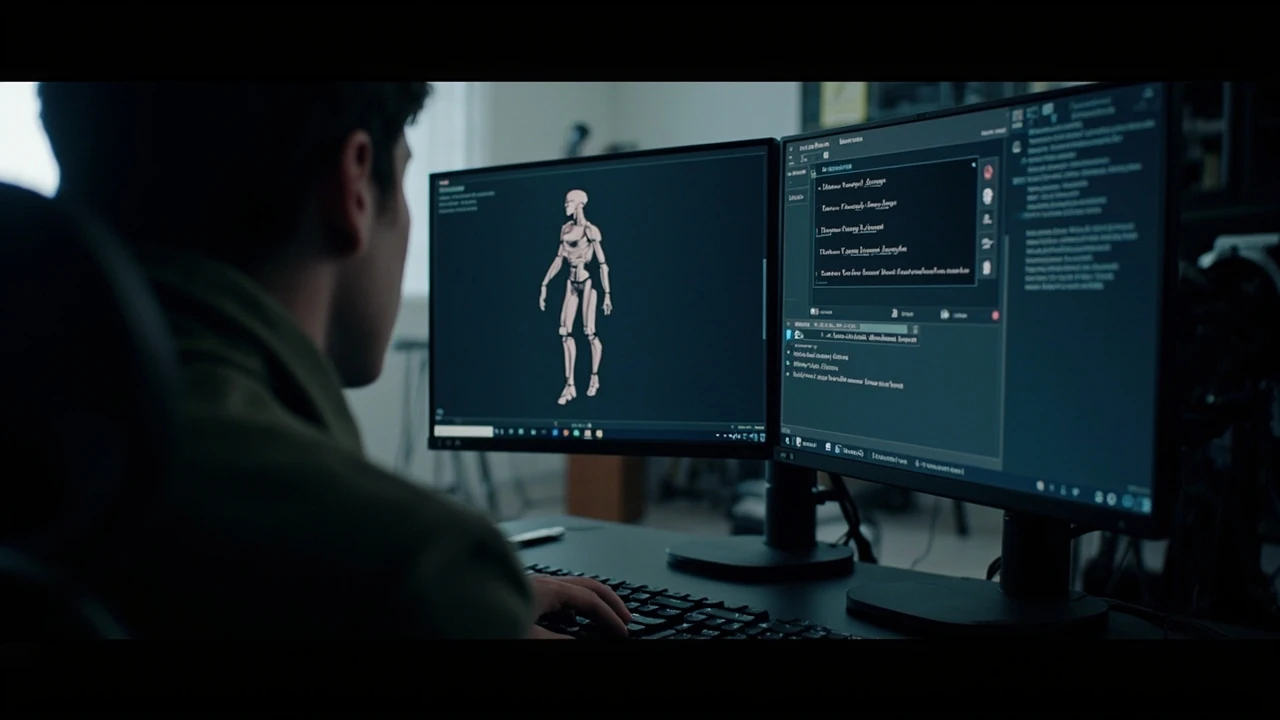
BG3 sex scenes: a production-side look at how Larian designs, animates, and ships them
A player opening Baldur’s Gate 3 for the first time is often surprised less by combat and more by how the romance scenes are staged. For developers, the surprise is technical: bg3 sex scenes sit at the intersection of mocap cleanup, facial animation, camera blocking, lighting, dialogue, and rating certification. Each one is a short cinematic inside a long RPG, and the cost of getting it wrong is visible in reviews, patch notes, and storefront age gates. This page is a production-side explainer for designers, animators, technical artists, and writers who want to understand the actual engineering work behind those moments, not a consumer guide or a content walkthrough.
The goal is to demystify the pipeline. We will look at how Larian Studios, the Belgian developer behind the title, treats romance scenes as authored cinematics, the constraints imposed by the game’s M-rating certification, the trade-offs between branching choices and reusable animation libraries, and the way lighting, camera, and audio shape the perceived intimacy of a scene. Where useful, we connect the choices back to broader game development practice: how you structure an animation bank, how you validate facial performance, and how you keep mature content compatible with a multi-platform release.
Why romance scenes are a technical problem, not just a writing one
In a CRPG with a runtime counted in hundreds of hours, romance scenes are tiny by byte size but expensive by attention cost. Players remember a single awkward camera move more clearly than a two-hour boss fight. The dev team’s job is to make sure the scene reads as intentional, and that means treating it as a cinematic that happens to share assets with gameplay, rather than as a script tacked on at the end of writing.
What a BG3 romance scene actually contains in the engine
Under the surface, a romance scene in BG3 is a sequence of actor states driven by the same dialogue system the rest of the game uses. When the dialogue line starts, a behavior tree triggers a state change on the two actors: walk to a position, sit, kneel, lie down, or face a specific direction. The state change plays a motion clip, often captured during mocap, and the camera cuts to a setup designed for the moment.
The scene is not a pre-rendered movie. It is a live scene using the in-game character models, the in-game lighting, and the in-game physics. That choice has consequences. It means body types, armor, and class equipment all show up in the scene. It also means the animation team cannot fully control what the player will look like when the scene plays, because BG3 supports a wide range of character creation presets.
The main components
- Dialogue track: the same system used for combat barks, with localized lines, lip-sync metadata, and emotion tags.
- Body animation: mocap clips retargeted to the in-game skeleton, with cleanup passes for collision and weight.
- Facial animation: a second pass of mocap or hand-keyed curves that drive the face rig, including eyes, brows, and jaw.
- Camera setup: pre-authored camera anchors that the engine blends between based on dialogue state.
- Lighting state: a scene-level lighting override that desaturates background, increases rim light, and tightens exposure.
- Audio state: a music and ambience crossfade to a dedicated cue, plus a ducked dialogue bus so breaths and lines are not masked.
The mocap pipeline that feeds the scenes
Larian’s motion capture for BG3 was performed with two actors per scene, captured simultaneously, on a clean stage. The performers are real people whose physical work is then retargeted to the stylized character rigs. The studio has discussed in interviews and behind-the-scenes materials that the captures were not shot in heavy costume; the team relied on the rigs to carry the character silhouettes, not on the mocap suits.
The retargeting step is where most of the visible problems come from. The in-game body proportions are stylized, with longer limbs and slightly different joint rotations than a human actor. A clip that looks correct on the mocap stage can read as stiff, over-extended, or off-balance once it is mapped to the character. Animators spend the majority of their time on this cleanup: smoothing joint transitions, matching the height of the body to furniture, and ensuring feet do not clip through beds, walls, or other actors.
Because the scenes are interactive rather than linear, the animators cannot lock the camera to a single frame. They have to design clips that hold up from multiple angles. The camera team uses this to its advantage by cutting around the body parts that animate least well, which is a standard cinematographic pattern but one that has to be authored into the data.
Facial performance and the problem of a stylized face
Facial animation is where the development cost is highest and where the smallest mistake is most visible. BG3 uses a face rig driven by a blend shape system, with separate controls for brows, eyelids, cheeks, mouth, and jaw. The performance capture feeds that rig through a solved pass, but the captured curves are then heavily edited by a facial animator.
Several factors make this hard in BG3 specifically:
- Stylized proportions. The face rig exaggerates eye size and brow geometry. Captured eye darts and brow raises need to be re-amped or they look uncanny.
- Camera close-ups. The romance scenes sit closer to the faces than the rest of the game, which exposes any issue in the rig.
- Lighting that flatters and exposes. Cinematic lighting sharpens shadows on the face. Any asymmetry in the rig becomes visible on one side of the nose.
- Localization length. Different languages run the same line at different speeds. The lip-sync and facial curves have to flex with that.
The result is that facial performance is mostly hand-keyed by senior animators, with the capture data treated as a reference rather than a final asset. That is expensive, and it is the main reason romance content takes longer per minute than combat content.
Camera direction: how the scene reads as intimate
The camera in a BG3 romance scene is not a single rig. It is a sequence of named anchors, each with a framing, lens choice, and transition rule. The dialogue system picks the anchor based on line emotion, scene beat, and previous framing, so the editor does not have to hand-author a camera cut for every line.
Several patterns repeat across scenes:
- Two-shot opening. Both characters in frame, often in a neutral staging that the player just walked into.
- Over-the-shoulder exchange. Standard dialogue coverage, but with shallower depth of field than the rest of the game.
- Single close-up on the active speaker. Triggered when the line is high-emotion or low-volume.
- Cutaway to hands or environment. Used to imply or hide action and to relieve the visual weight of a long take.
The depth-of-field change is small but consistent. The rest of BG3 uses a deeper focus so the player can read combat information. The romance scenes pull focus tighter. This signals to the player that the framing rules of the world have changed, without the team having to add a UI element or a fade to black.
Lighting: the cheapest and most effective tool
Lighting in the romance scenes is the single most effective way to communicate tone without changing the animation. Larian’s lighting team uses a small set of established patterns:
- Reduced key intensity. The main key light is dimmed relative to the surrounding scene, often shifted warmer.
- Stronger rim or kicker. One or both characters get a rim light that separates them from the background.
- Lower ambient. The fill is reduced, which deepens shadows and removes the flat daylight look of the rest of the game.
- Practicals emphasized. Candles, lanterns, and bedside lamps get a brighter role, both as sources of warm light and as composition anchors.
This is the same toolkit a cinematographer would use in live action. The reason it works in an engine is that the lighting pass for the scene is authored as a separate state, so it does not have to share light placements with the gameplay version of the same room.
Audio: what the player hears in a romance scene
The audio mix for a romance scene runs in parallel with the visual switch. The dialogue bus is dropped slightly to make room for room tone, breath, and fabric movement. The music cue is switched to a romantic or melancholic track, depending on the character arc, and is often played lower than the dialogue so that it reads as atmosphere rather than score.
Breath is the underrated tool. Players consistently read breath sounds as intimacy, even on actors they cannot see well. The audio team records or layers breath as a separate pass so it can be added on top of the performance without competing with the dialogue. That is also true for low fabric rustles and creaks, which signal proximity without explicit sound design.
Rating certification and the M-rating ceiling
BG3 is rated M for Mature by the ESRB and carries the corresponding PEGI 18 and CERO Z ratings in other regions. The M ceiling is the constraint that quietly shapes every production decision. The team has to keep the scenes inside the M framework for every regional rating body, while still delivering content that feels weighty to adult players.
Concretely, that means:
- No explicit nudity in shipped scenes. The characters are anatomically covered, and the camera is framed to imply rather than expose.
- Implied action over shown action. The scene fades or cuts to a tasteful angle when the implied action would otherwise be explicit.
- Dialogue and motion tuned to the rating. Some lines are written more conservatively in the final pass to avoid a higher rating bracket.
- No interactive content beyond the camera and dialogue. The player cannot prompt the characters or change the staging, which keeps the scene inside the M framework on every platform.
For developers shipping on multiple storefronts, this is the most common reason to design romance content conservatively first and adjust upward only when the rating allows. A scene that has to be edited down after rating submission usually loses both timing and continuity.
How Larian structures the scene library
BG3 ships with a large number of romance scenes, but it does not author a unique animation for every beat of every scene. The animation team works from a library of motion clips that the scene editor composes. The library breaks into several layers:
| Library layer | What it contains | Typical reuse | Editing cost |
|---|---|---|---|
| Base mocap | Clean, full-body performance captures, mostly two actors | Reused across multiple scenes with retargeting | Low to medium |
| Pose library | Hand-keyed static poses: sitting, leaning, lying, embracing | Used as anchors for transitions and as rest states | Low |
| Transition clips | Short motion segments that connect two states, often with a named entry and exit pose | Used to chain base mocap into a longer scene | Medium |
| Facial takes | Per-line facial curves, often re-edited from capture | Tied to specific dialogue lines and emotion tags | High |
| Camera anchors | Named camera states with framing and depth of field | Reused across scenes that share a room and mood | Low once authored |
The key production decision is the boundary between the base library and the scene-specific edits. The base library is the team’s leverage: any clip that is in the library is essentially free to reuse. Any scene-specific motion is full cost. The director and the lead animator decide together which beats of a scene are worth authoring from scratch, and which can be assembled from existing clips with a small edit.
Branching choices and the cost of authored variability
Larian’s Baldur’s Gate 3 shipped with seven full romance arcs across the Origins cast and the player character. Each arc includes several staged scenes, multiple camera setups, and localized dialogue. The cost of authoring that content is not a single number; it spreads across writing, casting, mocap, performance cleanup, technical art, audio, lighting, and certification. Treating the scenes as ordinary quest content underestimates the work; treating them as a separate cinematic tier overestimates the available budget.
Every romance arc in BG3 includes some branching. The player can make a small number of choices inside the scene, and a small number of choices before the scene that change how it plays. The branching is not dense: a typical scene has one or two meaningful forks, with a default path that the studio knows most players will see.
The reason branching is light is production cost. Every additional path needs its own dialogue recording, its own motion, and its own camera anchors. The cost grows multiplicatively, not linearly, because the branches share the staging but not the lines, and the actor’s body language has to differ between branches. Studios that try to author dense branching into mature cinematic content tend to overshoot both budget and schedule, and the average quality of the less-trodden paths drops.
BG3 solves this with two patterns:
- State-based staging. The scene stages the same physical arrangement, but the actor state changes based on a flag set earlier. The player sees the same bed and the same camera, but the actors are sitting instead of standing.
- Line-level swaps. The motion is shared across paths, and only the spoken lines and facial takes differ. The player reads the line as the divergence rather than the body.
Replayability and the player’s perception of variety
Players often note that romance scenes across different characters feel distinct, even though the underlying animation library is shared. That is a perception problem, not a content problem, and the studio solves it in a few ways.
- Per-character staging. Each character has a signature room, a signature prop, and a signature color palette, so the eye reads the scene as different even when the body language is similar.
- Per-character lighting. The lighting state is biased toward the character’s palette, which gives each scene a different temperature.
- Per-character camera grammar. Some characters are framed wider, some closer. Some are shot with warmer lens flares, some cooler.
For developers, the lesson is that perceived variety in cinematic content comes from direction, not from unique motion. Reusing a good library with good direction is cheaper than authoring unique motion with average direction.
Cross-platform consistency: PC, console, and the cloud version
BG3 ships on PC, on PlayStation 5, on Xbox Series, and on a cloud-streamed version. The romance scenes have to play on each of these targets with the same content. The constraint is not a technical limit on the content itself, since the scenes are short, but on the surrounding systems.
- Save compatibility. The flag that triggers the scene has to round-trip across platforms so a player who started on PC and moved to console still sees the same content.
- Localization parity. Every localized line has to be available on every platform, and the lip-sync curves have to be regenerated for each language so the facial animation still fits.
- Streaming bandwidth. The cloud version has to stream the scene with the same animation data. The scenes are not pre-rendered, so this is a non-issue for the scene itself but does affect the dialog and audio files.
- Input parity. Players using a controller have the same interaction surface as players on keyboard. Romance scenes do not add a new input, so this is the easiest of the four.
For shipping a multi-platform title, the lesson is that mature cinematic content should be designed against the lowest-spec target first, then enhanced on the higher-spec targets. The reverse is fragile: scenes that depend on high-end effects to read correctly will break on the lowest tier and force a costly redesign.
Modding and the community’s role in extending the content
BG3 has an active modding community, and a meaningful share of mods extends romance content in directions the studio did not ship. For developers, this is interesting because the engine exposes enough of the scene structure for modders to author new content without rewriting the game. Modders can:
- Add new dialogue lines that trigger the same scene state and play the same mocap.
- Replace the camera anchors with custom ones, including deeper close-ups and alternate angles.
- Add lighting overrides that shift the mood of the scene.
- Insert new state changes into the scene’s behavior tree so the actors perform new actions at the same anchor points.
None of this is accidental. Studios that ship mature cinematic content in a long-tail game benefit from exposing the scene data in a way that modders can read. It extends the lifetime of the content without costing the studio more authoring time, and it gives the team a real-world test bed for changes they might want to make to the official scenes in future patches.
Quality assurance for cinematic content
QA for romance content is not the same as QA for combat. The bugs that matter are different, and the testers who find them are different. Most studios assign the cinematic QA pass to a small group of senior testers who are calibrated on camera, audio, and animation, rather than to the larger combat QA pool.
| What it looks like | Most common cause | First place to look | |
|---|---|---|---|
| Camera pop | Visible jump or jump-cut between two anchors | Wrong transition rule or unmatched focal length | Camera director and lead animator |
| Facial freeze | Face stops moving for one or more lines | Broken curve import or missing keyframe | Facial animator |
| Body clip | Hand, knee, or head passes through a prop or another actor | Mocap retarget mismatch or staging pose overlap | Body animator |
| Audio desync | Line is heard before or after the corresponding lip-sync | Localization length or compressed audio segment | Audio team and localization lead |
| Lighting hot spot | Skin reads as blown out on close-up | Over-bright practical light, missing exposure clamp | Lighting artist |
| Continuity drift | Costume, prop, or actor position differs between shots in the same scene | State change with no matching rest pose | Scene director |
Most of these failures are not detectable by automated tests. They are detected by an experienced tester watching the scene with sound on, often at half speed, and noting the timestamp. The QA team’s bug database is the second-largest single source of iteration on romance scenes, after the lead animator’s own passes.
Performance budget: how the scenes stay within frame time
Romance scenes do not have a separate performance budget from the rest of the game. They run on the same engine, on the same hardware, with the same frame budget. That means the scenes have to keep within the same draw call, triangle, and CPU budget as a comparable combat moment. The studio budgets a romance scene against a complex combat encounter with two characters and a small environment, which is roughly the cost of a single tactical turn with full VFX.
The disciplines that keep the scenes inside budget are:
- LOD discipline. The actors use the same LODs as in combat. The studio does not allow a higher-detail LOD for romance scenes because the player can transition into and out of a romance scene in a single loading boundary.
- Lighting reuse. The lighting states for romance scenes are pre-baked where possible, with a small dynamic layer for the actors.
- Animation streaming. The motion clips for the scenes are streamed in with the dialogue track, not loaded with the level.
- Audio streaming. Music and breath tracks are streamed as well, which keeps the resident memory budget the same as a non-romance scene.
What developers can borrow for their own projects
For a studio that wants to ship its own romance content, the BG3 approach gives a usable template. The pipeline is not unusual, but the discipline is. Several patterns are worth copying directly:
- Build the library before the scenes. The base mocap, the pose library, and the transition clips have to be in place before the first scene is staged, or the scenes will cost more than they should.
- Treat lighting as a separate state. Author the lighting state for the scene rather than reusing the gameplay lighting. The cost is small and the visual return is large.
- Keep branching shallow. A small number of meaningful forks reads as more cinematic than a deep tree, because the director’s time goes into direction rather than into managing permutations.
- Design for the lowest-spec target first. A scene that holds up on the smallest screen with the smallest audio system will hold up on the largest. The reverse is fragile.
- Expose the scene data to your modding community. If the game is long-tail, the modding community will extend the scene data in ways the studio never predicted, and that extends the value of the content.
What BG3 does not do, and what that means for your project
BG3 also has a number of decisions that are specific to its design, and not every project should copy them.
- The player cannot customize the staging. There is no way for the player to change the camera or the actor positions. That keeps the production cost low and the rating clean, but it does not satisfy players who want more control.
- The player cannot have a same-sex scene with a character the player has not romanced. The character-specific arcs drive the scene selection. That keeps each character’s content focused, but it does mean that some combinations are not available.
- The scene fades or cuts at the implied action. The studio chose to keep the scenes inside the M rating. A project that wants a higher rating has more freedom, but also more certification work.
For developers, the takeaway is that BG3’s approach is one point in a larger design space. It is a sensible default for a long, branching CRPG with a mature rating, but it is not the only valid choice.
Production timeline for a single romance scene
To make the cost concrete, the table below summarizes the rough order of work for a single five-minute romance scene in a project of BG3’s scale. The numbers are not studio-confirmed and should be read as illustrative, not as a budget.
| Stage | Work | Main actor | Approximate share of scene cost |
|---|---|---|---|
| Writing | Drafting and revising the dialogue, including the localized version | Writer and editor | 10-15% |
| Casting and direction | Working with the voice actor to find the right read and timing | Voice director and actor | 10-15% |
| Voice capture | Studio session with multiple takes per line, including breath and ad-libs | Voice actor and audio engineer | 5-10% |
| Mocap | On-stage capture with both actors, including blocking variations | Mocap performers and stage team | 15-20% |
| Body cleanup | Retargeting, joint smoothing, collision, and prop contact | Senior body animator | 10-15% |
| Facial cleanup | Hand-keyed or capture-solved facial performance, including lipsync and brow work | Senior facial animator | 15-25% |
| Camera | Authoring anchors, transitions, and depth of field | Camera director | 5-10% |
| Lighting | Authoring the scene state, including practicals and rim lights | Lighting artist | 5-10% |
| Audio mix | Balancing the bus, crossfading music, and layering breath | Audio mixer | 5% |
| QA passes | Senior tester watching the scene at speed and half speed, logging failures | QA lead | 5-10% |
| Certification prep | Reviewing the scene against the rating board’s criteria and producing a clean cut | Producer and compliance lead | 2-5% |
The largest single line item is facial cleanup, which is consistent with the studio’s public comments on the cost of cinematic content. The smallest is certification prep, which assumes the scene was written conservatively in the first place. Studios that try to author the scene aggressively and then cut it down for certification tend to spend two to three times more on the final pass than studios that author against the rating from the start.
Common failure modes and how to avoid them
Most romance scenes in shipped games fail in one of a small number of ways. The list below names the most common ones and the discipline that prevents them.
- Stiff body language. Caused by under-cleaned mocap. The fix is to assign a senior body animator to every scene rather than rotating juniors through the work.
- Flat faces. Caused by treating facial animation as a step in the pipeline rather than as a craft. The fix is to give the facial team the same status as the body team and the same QA attention.
- Wobbly cameras. Caused by blending between anchors that are not designed to be blended. The fix is to author transition rules explicitly and to validate them on the lowest-spec target.
- Drab lighting. Caused by reusing the gameplay lighting state. The fix is to author a separate scene lighting state for every romance scene, even if it shares most of its parameters with the gameplay state.
- Audio that sounds identical to combat. Caused by not separating the audio bus for the scene. The fix is to author a dedicated bus and a dedicated music cue for each character arc.
How to plan a romance content track for a new project
For a studio that is scoping a new title and wants to include romance content, the planning sequence is roughly as follows. The list below is a starting point, not a fixed process.
- Decide the rating and the regional targets first. The rating shapes every decision that follows, and changing it later is expensive.
- Decide the number of arcs and the length of each. A typical arc in a long CRPG has three to five staged scenes. The number of arcs is the most expensive single decision in the content plan.
- Author the motion library before the scenes. Capture the base mocap and the pose library first, then stage the scenes on top of it.
- Author the lighting and audio states before staging. The scene states are small but they have to be in place before the scene can be staged.
- Build the camera grammar early. The camera anchors and transition rules are a shared resource. Get them in place before the first scene, not after.
- Plan the QA team and the QA process. Cinematic QA is a separate skill from combat QA. Identify the testers early.
- Plan for the patch. Players will find issues in the first weeks after launch. Reserve budget for a romance content patch in addition to the combat and balance patches.
Where the pipeline is likely to evolve
Several parts of the BG3 pipeline are likely to change in the next few years, and studios planning a long production cycle should be ready for them.
- Facial solving from video. Monocular facial performance capture is improving quickly. The cost of a facial take is likely to drop, but the cleanup cost is not.
- Real-time lighting in cinematics. Path-traced lighting in engines is moving from offline to real time. The cost of a separate lighting state for a scene is likely to fall.
- Localization automation. Automated localization of facial performance from text is a partial solution today and a likely near-term improvement. Studios that build a clean curve format now will benefit from it later.
- Player-controlled camera in cinematic content. Several shipping titles now let the player nudge the camera in a cinematic scene. The rating impact of that change is not yet clear, and it is the largest open question for studios that ship mature content.
Closing notes for production leads
The scenes are short, but the decisions behind them are not. They sit at the boundary between writing, animation, technical art, lighting, audio, and certification, and the studio’s job is to keep that boundary from becoming a fault line. The most useful thing a production lead can do is to give the scene team a single accountable director who can hold all of those crafts to the same bar, and a single QA lead who can give that director honest feedback on the result. Without that, the scene either gets too expensive or too thin, and the players notice both.
If you are working on a project that is going to ship romance content, the first concrete step is to look at the existing quest and cinematic structure and identify which scenes in your game would benefit from the kind of direction described above. Even a single scene, treated with the full production discipline, will tell you more about your pipeline than a dozen scenes treated as ordinary quest content. From there, the pattern extends. The work is small in bytes and large in attention, which is why it is worth doing carefully.
Frequently asked questions
Are BG3 sex scenes rendered in real time or pre-rendered?
They are rendered in real time. The scenes use the in-game character models, the in-game lighting, and the in-engine camera. Nothing about the romance scenes is pre-rendered, which is why the player’s character creation choices show up in them.
How long is a typical BG3 romance scene?
Most staged romance scenes run between three and seven minutes, depending on the arc and the player’s choices. The length is driven by the dialogue, not by the animation, and the dialogue itself is shaped by the same branching structure as the rest of the game.
How many romance arcs does BG3 have?
The shipped game includes seven full romance arcs across the Origin characters and the player character. Each arc includes several staged scenes, and the order in which they appear depends on the player’s progress through the main story.
Do BG3 sex scenes have an 18+ or AO rating anywhere?
No. The game ships with an M rating from the ESRB and a PEGI 18 in Europe. The scenes are authored to stay inside the M framework, which is why the camera is framed conservatively and the action is implied rather than shown.
Can the player change the staging of a romance scene?
No. The staging is authored by the studio and is the same for every player who triggers the scene. The player can make a small number of choices inside the scene, but the camera, the lighting, and the actor positions do not change based on those choices.
Do BG3 sex scenes support same-sex pairings?
Yes. Several of the romance arcs support same-sex pairings, and the player character’s gender does not lock the player out of any arc. The scenes are authored for the pairing the player has built, and the camera staging is the same in both cases.
How does Larian handle facial animation for romance scenes?
Facial performance is mostly hand-keyed by senior animators, with motion capture treated as a reference rather than a final asset. The face rig is a blend shape system, and the curves are tied to the dialogue’s emotion tags and to the localized line length.
What audio is in a romance scene?
The scene runs a dedicated audio bus, a dedicated music cue, and a layer of breath and fabric sound that is mixed in below the dialogue. The music is usually lower in the mix than the dialogue, which lets the line read as the primary content.
Can modders add new romance content to BG3?
Yes. The modding community has tools that can add new dialogue, new camera anchors, new lighting states, and new actor state changes. None of the new content is officially supported by the studio, and rating compliance is the modder’s responsibility.
What is the most expensive part of shipping a romance scene?
Facial animation is consistently the largest single cost. Body animation is the second largest. Together they account for roughly a third to a half of the total cost of a scene, which is why a small number of high-quality scenes is usually a better use of budget than a large number of average scenes.
Leave a Reply