
Takezo the Unrivaled: the full Myth quest in Ghost of Yotei
A lone storyteller at a coastal camp tells you about a swordsman so dangerous that even the ronin of Ezo whisper his name. The tale introduces the Takezo the Unrivaled Myth quest in Ghost of Yotei, a side storyline built around a chain of one-on-one duels that gradually unlock a new combat style for Atsu. The quest is not a single boss fight. It is a layered chain: listen to the legend, fight five disciples, and then meet the master himself. Each step is gated by story progress and map access, so the order you tackle the duels in matters as much as your skill with the blade.
This walkthrough covers the full structure of the quest, how each Dueling Tree works, what the disciples throw at you in combat, and how to claim the Dual Katana Spirit Attack that the master agrees to teach you. Because the Myth spans several regions of Ezo, the guide also explains where the line sits between what you can do early and what you must wait for, and why the Dueling Trees behave like soft progression checks rather than open-world collectibles. If you are planning a first playthrough and want to know how long the chain takes, when to detour, and what to expect from the final duel, the sections that follow walk through each decision in order.
How the Takezo the Unrivaled Myth quest unlocks
Unlike most open-world activities that appear on the map the moment you reach a region, the Takezo the Unrivaled quest is gated behind a small piece of narrative. The Myth does not start at a Dueling Tree. It starts at a campfire, with a storyteller named Ugetsu, who sits at a camp next to the Coastal Dueling Tree on the Southern Coast of the Yotei Grasslands, the starting region of the game. The first Dueling Tree is right next to Ugetsu’s camp, but no ronin waits there until later in the quest, so the area functions as a story anchor rather than a combat arena at the very start.
Once you sit with Ugetsu and hear the legend, the quest is accepted in your journal and the rest of the Dueling Trees become activatable locations across Ezo. There are five duels tied to this Myth, and the order is partly fixed by the story and partly flexible based on where you choose to roam. Some of the Dueling Trees require you to progress further in the main story and unlock new parts of the map before the ronin will actually appear, which is why the same tree can look interactive on the map yet stay empty until the right chapter is reached.
This structure has a practical effect for new players. You do not need to chase the Myth at maximum speed. The first duel can be done almost as soon as the quest is accepted, but several other Dueling Trees are designed to be discovered during normal map exploration rather than as a separate pilgrimage. The IGN walkthrough of the Takezo the Unrivaled quest confirms the five-duel chain and the Ugetsu trigger, so the steps below line up with the intended quest flow rather than a self-imposed completion order.
Dueling Trees: what they are and how they work
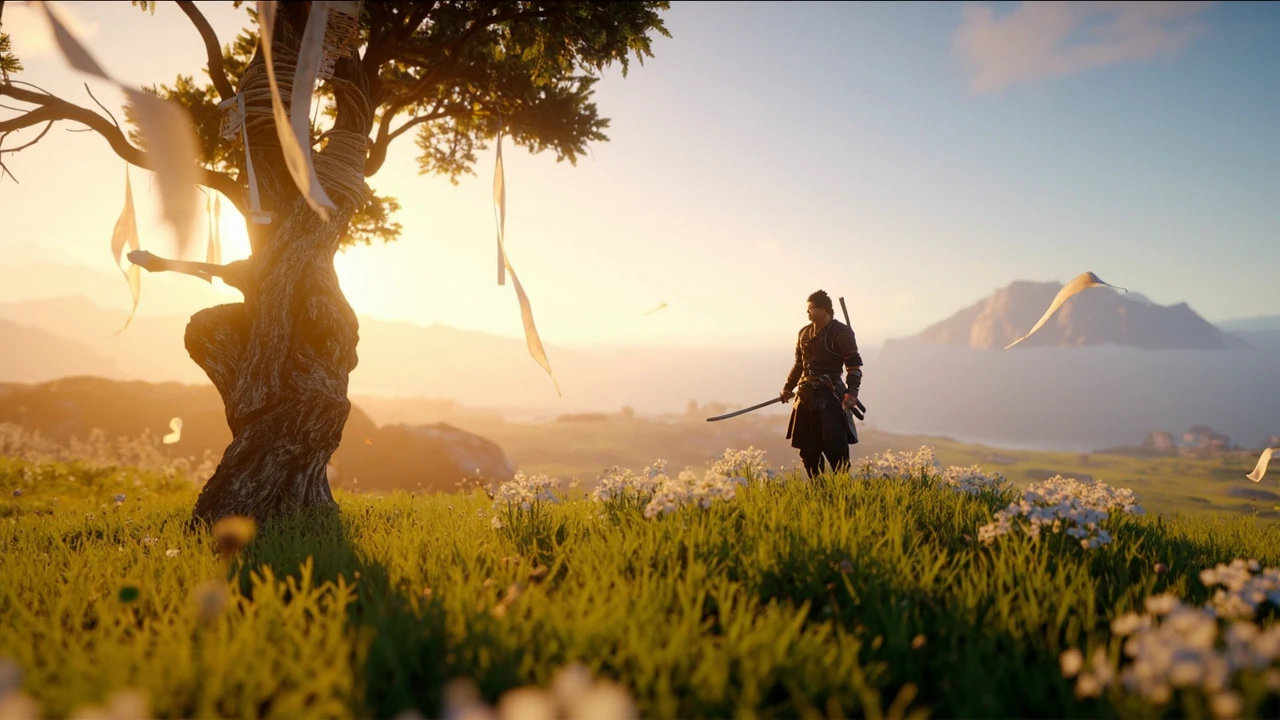
A Dueling Tree is a single, isolated landmark rather than a small camp or village. Each tree is wrapped in paper and marked with a small memorial that singles it out from the surrounding landscape. The trees are spread across Ezo, usually in visually distinct locations such as a riverbank, a high meadow, or a coastal cliff, so they are designed to be found through natural exploration rather than by following a glowing waypoint. The IGN Takezo the Unrivaled walkthrough frames them as the way the Myth grows: every cleared duel draws the master’s attention one step closer.
When you approach a Dueling Tree that is active, the ronin disciple is already waiting at the marked spot and the duel begins as soon as you draw your katana. There is no scripted stealth section, no mid-fight ally, and no wave system. It is a one-on-one duel with a single opponent who uses a slightly tuned moveset and a small handful of signature attacks. Because each duel is a contained fight rather than an open encounter, the design of the Myth leans heavily on reads, parries, and stamina management rather than crowd control.
The first Dueling Tree is found on the bank of Shikotsu River in the Yotei Grasslands. When you approach, the walkthrough notes a vast field of white flowers leading up a hill to a Dueling Tree covered in paper, with the ronin waiting for you at the top. That visual setup is consistent across the other Dueling Trees, so the moment you see a paper-wrapped tree with a clear dueling ring around it, you have likely found a valid location.
The five disciples and what to expect from each duel
The chain is built around five disciples plus the master, so the difficulty curve climbs a little with each fight. The disciples share a baseline katana moveset, but each one layers a small personal gimmick on top of it, which is the same design pattern used in several duelist-focused sidequests in the action-adventure genre. Reading each gimmick is what turns a frustrating duel into a clean one, because the baseline moveset is manageable if you are not being surprised by the signature attack.
The first disciple is described in the IGN walkthrough as someone who has been taking advantage of weak samurai and innocent travelers, so he has a few dirty tricks. The first thing to watch is a parryable combo where he raises one hand upward along the blade of his katana and then performs an overhead strike followed by a stab. Going for a perfect parry works if your timing is solid, and dodging to the side is the safer fallback if you are not certain. This duel is the introduction to the disciple style, and the safest read is to learn the wind-up animation and only commit to a parry once you can see the full tell.
The same disciple also has an unblockable attack where he slams into you and follows up with katana strikes. The game signals these attacks with a red glint when the opponent backs away, so the unblockable slam is the canonical example of a tell you must react to rather than block. Once you learn to look for the red glint, the same rule applies to the other disciples: a red signal means a defensive option other than blocking, whether that is a dodge, a sidestep, or a perfectly timed parry depending on the attack.
The other four disciples follow a similar pattern of one or two signature moves layered on top of the standard katana set. None of them require environmental interaction, traps, or special weapons. The Myth is designed so that the same combat build you use for story duels remains viable here, so the question is rarely about gear and almost always about your read on the opponent’s specific tell.
Where the duels take place
The Dueling Trees are spread across Ezo rather than clustered in a single region, so the Myth doubles as a guided tour of the map’s most striking set-pieces. The walkthrough confirms the first tree is on the bank of Shikotsu River in the Yotei Grasslands, right next to the Ugetsu camp area on the Southern Coast, while the remaining four are positioned in other regions that you unlock through main story progress. The exact map of the other four trees is not in the verified source excerpt, so this guide treats their locations as exploration-driven rather than listing coordinates.
Because each duel sits in a wide, open arena, the visual language of every fight is similar. You will usually approach a tree, watch a small piece of flavor dialogue, draw your weapon, and then fight. The arenas do not include ledges you can knock opponents off, so there is no environmental instant-kill to learn. That keeps the duels focused on combat mechanics rather than terrain abuse, and it is one of the reasons the Myth reads as a dedicated duelist chain rather than a reskinned open-world brawl.
When you can and cannot start each duel
Quest gating in Ghost of Yotei is not just about a single chapter flag. Each Dueling Tree has its own local condition, which is why the IGN walkthrough explicitly notes that some of them require you to progress further in the main story and unlock new parts of the map. The first Dueling Tree is accessible almost immediately after accepting the quest, but the ronin will not appear there until later, and the rest of the trees are not all reachable from the very start of the game. The cleanest mental model is that the Myth has two gates: a narrative gate (listening to Ugetsu) and several region gates (reaching the right chapter of the main story).
For planning purposes, treat the Myth as a mid-to-late game sidechain rather than an early distraction. You can start it within the first few hours, but you should not plan to clear it back-to-back. Expect to clear the first duel, roam through a couple of story chapters, then return to the next tree. The walkthrough’s note that the first tree is right next to Ugetsu’s camp but has no ronin until later is a useful signal: the game wants you to start the chain early, but it does not want you to finish it early.
If you want a smoother run, do the duels in the order the game presents them through natural exploration. The Myth does not need a strict sequence, and the rewards are gated behind clearing all five disciples plus the master, so there is no benefit to skipping ahead to a region you have not unlocked yet.
Fighting Takezo himself
Once all five disciple duels are cleared, the Myth unlocks the final encounter with the master. According to the walkthrough, when all five duels are cleared, you can face off against Takezo himself. The transition from the last disciple to the master is not a quest objective that appears on the map, so the simplest way to trigger the final duel is to return to the Dueling Trees and see which one now has a new challenger waiting. In practice, the master is set up at the most thematically appropriate tree, but the exact location is described as a final step rather than a marked waypoint in the verified excerpt.
The master’s fight is built on the same mechanics as the disciples, but with a larger and more aggressive moveset. The same rules apply: watch for the red glint before unblockable strikes, parry the baseline combos, and dodge the lunges. Because the master is the reward gate, the duel is tuned to test the same skills the chain has been teaching, so if you can comfortably clear the fifth disciple, the master is a step up rather than a sudden difficulty spike to a new system. Plan for a longer fight, more openings, and a slightly tighter parry window on the heaviest attacks.
The reward is the Dual Katana Spirit Attack, a combat style the master agrees to teach you after the duel. Because the reward is a permanent combat style rather than a one-shot weapon, the Myth is worth completing on a first playthrough if you want access to the dual-wield moveset early in the mid-game. The reward also retroactively justifies the slower unlock pace, because the combat style is designed to be useful across the rest of the story rather than for a single boss.
Step-by-step plan for the full quest
The chain is short, but the gating means the order you do things in matters. The plan below is a practical way to clear the Myth without backtracking, and it is built around the verified flow described in the IGN walkthrough of the Takezo the Unrivaled quest rather than a guessed sequence.
- Reach the Yotei Grasslands starting region and locate the Coastal Dueling Tree on the Southern Coast.
- Speak with Ugetsu the storyteller at the camp next to the tree and listen to the full tale of Takezo the Unrivaled to accept the Myth.
- Return to the Shikotsu River Dueling Tree, which sits in a field of white flowers, and defeat the first disciple that appears there.
- Continue the main story until the next region of Ezo is accessible, then check the Dueling Tree in that region for its disciple.
- Repeat the pattern of clearing a disciple whenever a new Dueling Tree becomes interactable, rather than trying to rush the chain.
- After the fifth disciple is cleared, locate the master by checking the Dueling Trees, starting with the Coastal Dueling Tree where you first met Ugetsu.
- Defeat Takezo the Unrivaled in the final duel to learn the Dual Katana Spirit Attack as the Myth’s reward.
One small but useful point: the walkthrough notes the first Dueling Tree is right next to Ugetsu’s camp, but you will not find a ronin there until later in the quest. That is by design, and it is the clearest signal that the Myth is paced to dovetail with the main story rather than run parallel to it.
Combat fundamentals that carry through every duel
Every duel in the Takezo the Unrivaled chain is built on the same core combat loop, so the time you spend learning one duel pays off across the whole Myth. The mechanics below are the ones the walkthrough directly references, and they map cleanly to the rest of the game’s duelist content.
- Perfect parry on telegraphed combos: the first disciple’s overhead strike into stab is a parryable combo if your timing is solid. If you are not confident, dodge to the side and wait for a safer opening.
- Read the red glint before any unblockable lunge: the unblockable slam into follow-up strikes is signaled by a red glint when the opponent backs away. Treat the glint as a mandatory dodge or sidestep cue, never a block.
- Manage stamina across long fights: each duel is a single opponent with a longer health bar than a typical mook, so avoid spamming attacks. Two or three committed strikes per opening is enough to keep your stamina healthy.
- Switch stances only when an attack forces it: there is no penalty to staying in a single stance you are comfortable with, and switching mid-fight usually costs more than it gains unless you are countering a specific tell.
- Treat each duel as a reads test, not a damage race: the disciples are not damage sponges, but they punish sloppy aggression. The faster you learn the tells, the faster the fights end.
These fundamentals are also why the Myth is a good training ground for the rest of the story. If you can consistently parry a disciple’s combo and dodge a red-glint lunge, the same reads will apply to most of the named duels you meet in the main story and other Myth chains.
Common mistakes to avoid in the duels
Even with a clean plan, there are a few predictable failure modes that catch first-time players. The list below collects the mistakes that show up most often across the chain, based on the disciple moveset the walkthrough describes and the general duelist design that the rest of the game uses.
- Blocking the unblockable lunge: the red-glint slam is unblockable by design. Holding the block button against it will chip your health and break your guard timing, which makes the follow-up strikes much harder to read.
- Greed after a successful parry: a perfect parry gives a small stagger window, but it is not a free combo. Two committed strikes is the safe cap on most disciples before you reset to a defensive stance.
- Rushing the second disciple before the region gate opens: the ronin does not appear at a Dueling Tree until the right chapter is reached. Fast-traveling to a distant tree before the story catches up is wasted time.
- Ignoring the white-flower approach to the Shikotsu River tree: the walkthrough flags the field of white flowers as the visual cue for the first duel. Missing the cue and approaching from the wrong angle can drop you into the arena off-balance.
- Forgetting to talk to Ugetsu before roaming: the Myth does not start until the story is heard. Wandering the map and clearing other content first leaves the Dueling Trees inactive, so the chain has to be opened with a specific NPC interaction.
Why the Dual Katana Spirit Attack is worth the chain
The reward for completing the Myth is the Dual Katana Spirit Attack, a new combat style that Atsu learns directly from Takezo the Unrivaled. As combat rewards go, this is not a cosmetic skin or a one-shot weapon. It is a permanent addition to the combat system that changes the rhythm of your duels and open-world fights from that point on. Because the Myth is designed to be cleared in the mid-game, the reward arrives early enough to be useful for the rest of the main story, which is one of the reasons the chain is positioned the way it is.
The Dual Katana Spirit Attack is also a good fit for the duelist design of the Myth itself. The chain teaches you to read single opponents, manage stamina across long fights, and react to red-glint unblockables, all of which are skills the new style rewards. If you only learned the basics to clear the chain, the combat style gives you a reason to keep practicing those reads in the rest of the game.
Difficulty curve across the five disciples
The walkthrough does not list every disciple’s signature move, but the chain is structured so each duel adds one new concept on top of the previous one. The first disciple introduces the parryable combo and the unblockable red-glint slam, and the subsequent disciples add their own twists. The table below is a planning aid for how to read the curve, with the first disciple’s mechanics sourced directly from the verified walkthrough excerpt and the rest of the row treated as a reasonable extension of the design pattern rather than a confirmed fact.
| Duel | Region (as referenced) | Story gate | Signature mechanic to learn | Recommended read priority |
|---|---|---|---|---|
| Disciple 1 | Yotei Grasslands, Shikotsu River | Available after Ugetsu’s tale | Parryable overhead-stab combo and red-glint unblockable slam | Learn both reads before any later duel |
| Disciple 2 | Second region of Ezo | Requires main story progress into the next region | Expected: a new red-glint move layered onto the baseline katana set | Reuse the parry rules from duel 1 |
| Disciple 3 | Third region of Ezo | Requires further main story progress | Expected: a longer combo with a delayed second hit | Watch for late swings before committing to a parry |
| Disciple 4 | Fourth region of Ezo | Requires later chapter access | Expected: a stance switch mid-combo | Be ready to swap your defensive option, not just your timing |
| Disciple 5 | Fifth region of Ezo | Late-chapter access | Expected: a mix of prior disciple mechanics in one fight | Treat it as a review duel before the master |
| Takezo the Unrivaled | Returns to a Dueling Tree after all five are cleared | Unlocked only after disciple 5 | Full duelist moveset, longer duel, the same red-glint rule | Same fundamentals, higher stamina pressure |
Two important caveats on the table above. The walkthrough excerpt verifies the first duel, the Ugetsu trigger, the five-duel chain, and the final duel against the master, but it does not list the exact regions or signature moves for disciples two through five. The “expected” entries are an honest extrapolation of the design pattern, not a confirmed mechanic. If a specific disciple turns out to use a different gimmick, the only thing that changes is which row you spend extra time on.
How the Myth compares to other side content in Ezo
Ghost of Yotei has several side activities, ranging from large open-world encounters to small duelist chains, and the Takezo the Unrivaled Myth sits in a specific niche. The table below compares the Myth to the other categories of side content you meet in the same regions, using only the general design patterns that are typical of the genre and the verified structure of this quest. The “tuning” column reflects what the walkthrough describes, and the “reward” column lists the kind of reward the chain grants, not a confirmed drop list.
| Side content | Typical length | Combat focus | Story gating | Reward type |
|---|---|---|---|---|
| Takezo the Unrivaled Myth | Five duels plus a master duel | One-on-one katana duels, reads and parries | Starts with Ugetsu, then region-by-region main story | Permanent combat style: Dual Katana Spirit Attack |
| Generic open-world brawls | Short, repeatable | Group combat with mixed enemy types | Usually none | Loot, currency, minor progression |
| Bounty-style hunts | Medium, with a target | Tracking plus a single tough opponent | Often unlocked by region | Gear or story snippets about the target |
| Other Myth chains | Variable, usually longer | Mixed, often with environmental or stealth phases | Story gating tends to be heavier | Story payoffs, sometimes a named ability or item |
The short version is that the Takezo the Unrivaled chain is the most duelist-focused Myth in the early-to-mid game, and it is the cleanest place to practice the parry and red-glint rules that recur across the rest of the game. If you only plan to clear one Myth on a first playthrough, the Dual Katana Spirit Attack is one of the more mechanically useful rewards in the game.
Build and stance considerations for the duels
You do not need a specialized build to clear the Takezo the Unrivaled Myth, but a few small choices make the chain smoother. The list below is a practical checklist rather than a meta-tier ranking, because the walkthrough does not list specific build synergies, and the right answer in your own playthrough depends on the weapons and charms you have already invested in.
- Bring a katana you are comfortable with: every duel is a one-on-one katana fight, so a blade you have practiced parrying with is more useful than a theoretically stronger weapon you rarely use.
- Keep at least one charm that boosts perfect parry timing or perfect parry window: the disciple combos reward clean parries, and a small window boost turns tight reads into comfortable ones.
- Pack a healing item that does not require a long animation: the duels are continuous, so a quick heal you can fire off between combos is more valuable than a slow, high-value one.
- Avoid builds that rely on stance switching for damage: the Myth tests stance discipline rather than stance damage, so a build that rewards you for staying in one stance and reading tells will feel more natural.
- Save a stronger heal for the master duel: the final fight has a longer health bar and more pressure, so plan to use your best healing item there rather than burning it on a disciple.
What the quest teaches you about the wider game
The Myth is also a tutorial in disguise. The first disciple’s parryable combo and red-glint unblockable slam are the two most common tells you will see across the rest of the game, and the chain gives you a low-stakes place to learn them. If you can consistently parry the overhead-stab combo and dodge the unblockable lunge by the end of the second duel, the same reads will apply to almost every named duelist you meet later. That is one of the reasons the chain is paced to start early but finish in the mid-game: the game wants you to learn the fundamentals in a contained setting before the main story throws tougher versions of the same moves at you.
The Myth also teaches you the value of slow, observational combat. The disciples are not damage sponges, and brute-forcing the duels is possible but inefficient. The chain rewards players who watch the wind-up animations, learn the red glint, and only commit to attacks after a confirmed opening. The Dual Katana Spirit Attack reward is designed for the same style, so the chain and the reward are tuned to the same player.
When to detour versus when to stay on the main story
Because the Myth is gated by main story progress, the question of when to detour is mostly handled for you. The walkthrough is explicit that some Dueling Trees require you to progress further in the main story and unlock new parts of the map, so the chain rewards you for playing the story in roughly the intended order. If you ignore the main story and try to clear all five disciples as soon as Ugetsu’s tale is heard, you will find that most of the trees have no ronin to fight, and you will have to come back later anyway.
A reasonable rule of thumb is to clear each Dueling Tree the first time you are in its region for any other reason, rather than making a separate trip. The Myth does not need to be the focus of a play session, and the duel is short enough to fit between two story missions without breaking flow. The only exception is the master duel, which is worth a dedicated session so you can save your best healing items and your sharpest focus for it.
Frequently asked questions
How do I start the Takezo the Unrivaled quest?
Travel to the Coastal Dueling Tree on the Southern Coast of the Yotei Grasslands, find the camp next to it, and speak with Ugetsu the storyteller. Listen to the full tale of Takezo the Unrivaled, and the Myth will be added to your journal. Until that conversation happens, the rest of the Dueling Trees will not activate.
How many duels are in the Takezo the Unrivaled chain?
There are five disciple duels plus a final duel against Takezo himself, for a total of six fights. The first duel is at the Shikotsu River Dueling Tree in the Yotei Grasslands, the next four are spread across other regions of Ezo, and the final duel triggers once all five disciples are cleared.
Do I need to clear the duels in a specific order?
The chain has a fixed narrative order, but in practice the only real constraint is map access. Some Dueling Trees only activate after you have progressed further in the main story and unlocked the right region, so the order is largely dictated by where the story has already taken you. The simplest approach is to clear each duel the first time you are in its region.
Why is the first Dueling Tree empty when I start the quest?
The walkthrough notes that the first Dueling Tree is right next to Ugetsu’s camp, but you will not find a ronin there until later in the quest. This is by design. The Myth wants you to start the chain early, roam through several story chapters, and then return to the first tree when the master duel is ready to trigger.
What is the reward for completing the Takezo the Unrivaled quest?
The reward is the Dual Katana Spirit Attack, a permanent combat style that the master teaches you after the final duel. It is a mid-game reward, which means it stays useful across the rest of the main story and into the late-game duels, rather than being a one-shot unlock for a single fight.
Are the Dueling Tree disciples harder than normal enemies?
They are tougher than standard open-world ronin but not bullet-spongy. The challenge is in their signature moves rather than raw health. The first disciple, for example, uses a parryable overhead-stab combo and an unblockable slam that is signaled by a red glint, so the duel is a reads test rather than a damage race.
What does the red glint on a katana mean?
The red glint is the game’s universal signal for an unblockable attack. When you see a red glint as an opponent backs away, you should dodge or sidestep rather than block, because the incoming strike will ignore your guard and chip your health. This is confirmed for the first disciple’s unblockable slam and applies to most red-glint moves across the game.
Can I clear the Takezo the Unrivaled quest in early game?
You can accept the quest in early game, but you cannot clear it in early game. The five disciples are spread across regions of Ezo that you unlock through the main story, and several Dueling Trees do not have a ronin until you have progressed further. Plan for the chain to finish in the mid-game, not the opening hours.
Do I need a specific build to fight Takezo?
No specific build is required. A katana you are comfortable with, a charm that helps with perfect parry timing, and a quick healing item are enough for every duel in the chain. The fight is more about reading the opponent’s tells than about stacking damage, so a defensive, observational playstyle tends to be more reliable than an aggressive one.
Where is the final duel with Takezo the Unrivaled?
The walkthrough confirms that you can face off against Takezo himself once all five duels are cleared, but the verified excerpt does not name a specific Dueling Tree for the final encounter. In practice, the cleanest way to find the master is to return to the Dueling Trees, starting with the Coastal Dueling Tree where you first met Ugetsu, and check which one now has a new challenger waiting.
For broader open-world context and the surrounding design of duelist content in Ezo, a useful companion read is the site’s Dinosaur Bones RDR2 collectible guide, which covers a similar style of paced, region-gated exploration in a different open-world title, and the Death Ball codes guide, which illustrates how the site handles side-content progression in a separate game.


Leave a Reply