
Dinosaur bones RDR2: where to find every fossil in Red Dead Redemption 2
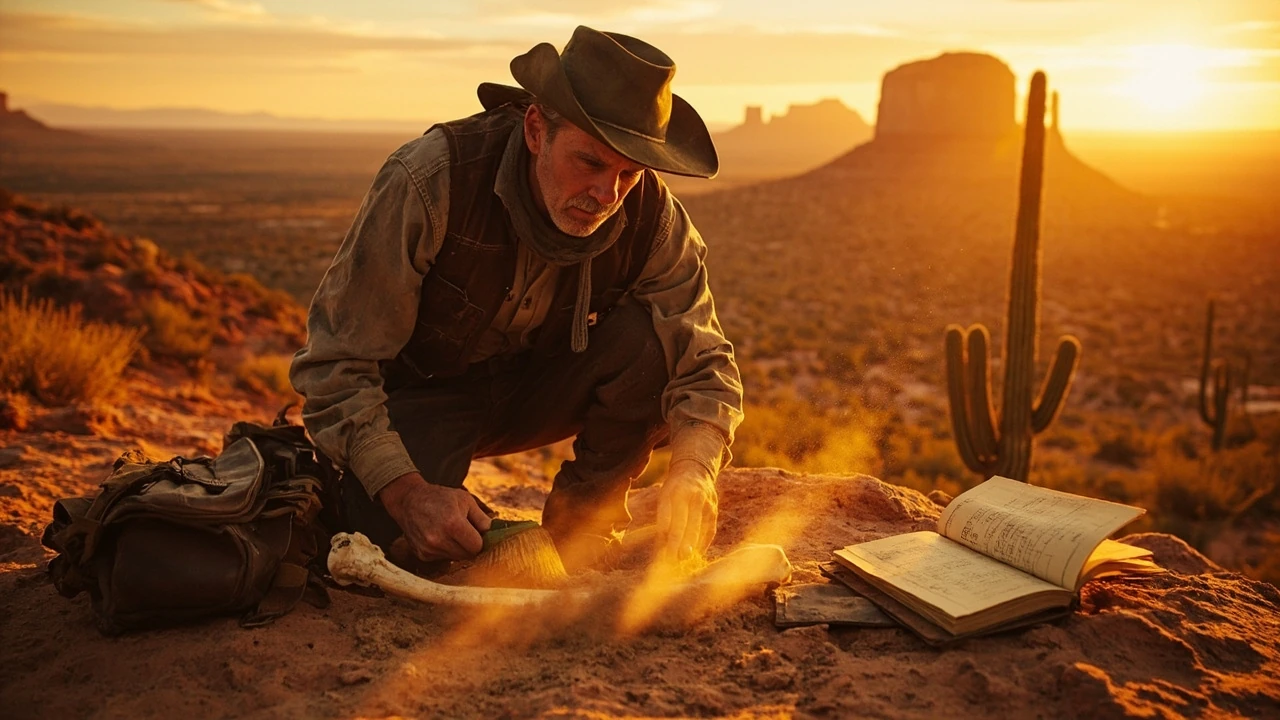
A single dinosaur bone on a dusty rock ledge in New Austin opens one of the quietest completion tasks in Red Dead Redemption 2. It belongs to Deborah MacGuiness, a former schoolteacher turned amateur paleontologist, and mailing all thirty specimens to her triggers a short scene at the Rhodes train station. The task never appears on the main map, never points the player with a beam of light, and never ticks a counter in a menu, so most players stumble into it by accident after a random campfire chat. The guide below lays out every spawn point, a sensible travel order, and the small details that decide whether a sweep feels clean or turns into a frustrating search.
The dinosaur bones in RDR2 are not DLC and not part of the Stranger Missions list. They sit in the same free-form content bucket as the cigarette cards, the dreamcatcher feathers, and the rock carvings. Each bone is interactable, each sits in a fixed world location, and each is technically optional, which is why so many players end up missing one or two. The breakdown is built for completionists, for players who want the credit, and for anyone who has ever wondered what those long bones jutting out of rock faces actually are.
What the dinosaur bones quest actually is in RDR2
The quest is internally called “A Test of Faith” and is delivered by Deborah MacGuiness after a brief story beat in the main campaign. She asks the player to send her any interesting fossils found in the wild. Mechanically, the player walks up to a bone, interacts with it, and sends it by mail through the in-game post. There is no timed delivery, no escort, and no combat. The only failure states are misplacing a letter at the post office or never returning to a spawn point that respawns on a long timer.
What makes the quest feel different from other side content is its lack of feedback. There is no journal update, no objective marker, and no on-screen tally. The only confirmation arrives when the player returns to Deborah and hears new dialogue. Completion unlocks a hand-drawn treasure map and a small cash reward, both of which are covered further down in this article.
Why a fossil map matters in an open-world game
Red Dead Redemption 2 leans heavily on low-feedback optional content. The dreamcatcher feathers, dinosaur bones, and rock carvings share a design philosophy: drop a small unique object somewhere visually hidden, give the player a single line of in-game context, and offer a tangible reward for thoroughness. From a design angle, the system encourages exploration through curiosity rather than direction. From a production angle, it is an inexpensive way to populate a huge map with reasons to revisit terrain the player has already crossed.
Players looking for a full list are not shortcutting the experience. They are working around a design choice that does not respect limited play time. Knowing the location of a specific bone is the difference between a fun detective game and an unfocused hike across three biomes.
How to unlock the dinosaur bones quest
Deborah MacGuiness becomes available after the player pushes far enough into Chapter 6 of the main story. The exact story beat is reached after the final mission of the chapter, which is also the point at which the player gains the freedom to roam the entire map without scripted interruptions. Deborah is found in a tent near the train station in Rhodes, in the Heartlands region of New Hanover.
After speaking with her, the player is free to begin sending bones. There is no minimum bone count before she will speak again, since she responds after every shipment. This makes the quest forgiving: players can collect in any order, return to her at any time, and resume collecting if they stop playing for weeks.
What you actually do at each bone site
Every bone in the world is a static mesh that the player can approach and interact with. The interaction is a short context-sensitive prompt, usually labelled “Examine” or “Send to Deborah MacGuiness.” Picking it up adds the fossil to the player’s letter pouch, and the letter is automatically stamped and addressed. The next visit to any post office lets the player mail the letter, which is the moment the bone is considered “sent” for progression purposes.
Two practical rules come from this flow. First, do not leave a letter sitting in the pouch indefinitely, because quest progress only ticks after the player opens the post office menu and confirms the shipment. Second, do not confuse the bone with a random animal skeleton: dinosaur bones are large, curved, and embedded in rock, not lying in the open on grass.
Two useful tools for a clean sweep
Two inventory items make the run noticeably faster. The first is a reliable fast-travel option. Red Dead Redemption 2 does not offer a free teleport, but the player can buy a stagecoach fast-travel ticket from any station and zip between regions. The second is a good horse. The Arabian, the Turkoman, and the Missouri Fox Trotter all have the stamina and speed to handle long cross-map runs without constant rest. Both are optional, but both save real time when the route is planned.
A field journal or notebook is also useful. Because the quest does not maintain an in-game checklist, players who do not keep notes often return to a previous bone site by accident, convinced they missed a spawn.
The full list of dinosaur bone locations
The table below lists every confirmed bone in the base game, organised by the geographic region that appears on the in-game map. The numbering follows the order in which most players tend to collect them when running a west-to-east sweep. It is not the order dictated by the quest itself. Terrain notes are included because several bones sit on cliff edges that are easy to slip off, especially in heavy rain.
| Number | Region | Terrain note | Visual cue |
|---|---|---|---|
| 1 | New Austin, Gaptooth Ridge | South slope of the ridge, on a rock shelf | Long curved bone next to a cacti cluster |
| 2 | New Austin, Rio Bravo | East bank, near a small cave mouth | Bone half-buried in sand at the cave entrance |
| 3 | New Austin, Cholla Springs | Flat desert near a rock formation | Bone visible against pale sand |
| 4 | New Austin, Armadillo | Outside town, near a fenced corral | Bone beside a broken wagon |
| 5 | New Austin, Tumbleweed | Edge of town, on a sandy rise | Bone near a windmill base |
| 6 | New Austin, Rathskeller Fork | North bank, by a tree line | Bone in a creek bed |
| 7 | West Elizabeth, Big Valley | Near a logging camp | Bone on a stump |
| 8 | West Elizabeth, Tall Trees | South of the lake, in dense forest | Bone by a fallen log |
| 9 | West Elizabeth, Great Plains | Open grassland, near a small pond | Bone by a single large rock |
| 10 | West Elizabeth, Black Bone Forest | Hidden between tall pines | Bone in a clearing at dusk |
| 11 | West Elizabeth, Lake Don Julio | Cliff above the lake | Bone on a narrow ledge |
| 12 | West Elizabeth, Aurora Basin | Snowfield, by a frozen tree | Bone in a snowdrift |
| 13 | West Elizabeth, Mount Shann | Mid-elevation slope | Bone on a rocky outcrop |
| 14 | New Hanover, The Heartlands | Open plain near a fence line | Bone beside a dead tree |
| 15 | New Hanover, Cumberland Forest | North edge, near a lumber mill | Bone by a wood pile |
| 16 | New Hanover, Roanoke Ridge | Cliff above the road | Bone in a hard-to-reach notch |
| 17 | New Hanover, Big Valley (east) | Near a stagecoach stop | Bone by a signpost |
| 18 | New Hanover, Scarlet Meadows | South field, near a farm | Bone in tall grass |
| 19 | New Hanover, Bayou Nwa | Swamp edge, on dry ground | Bone by a cypress tree |
| 20 | New Hanover, Bluewater Marsh | Railroad side, by a bridge | Bone under a trestle |
| 21 | New Hanover, Caliga Hall | North of the manor, by a pond | Bone on a hilltop |
| 22 | New Hanover, Rhodes | Town outskirts, near the station | Bone by a rail tie stack |
| 23 | New Hanover, Thieves’ Landing | Edge of town, near a derelict boat | Bone by a broken dock |
| 24 | New Hanover, Lagras | Swamp path near a ruin | Bone on a stone ruin |
| 25 | New Hanover, Houseboat | By a houseboat on the river | Bone in shallow water |
| 26 | New Hanover, Lakay | Swamp clearing | Bone on a small island |
| 27 | New Hanover, Saint Denis | Industrial district, near warehouses | Bone by a brick wall |
| 28 | New Hanover, Saint Denis docks | End of a pier | Bone by a bollard |
| 29 | New Hanover, Old Tomb | On a hill, by a small cemetery | Bone near a gravestone |
| 30 | New Hanover, Bolger Glade | Hidden glade, north of the main road | Bone in dense brush |
Bone numbers can shift based on the player’s chosen route, because the spawns themselves are not numbered in the world. The table is a working reference, not a hard script. Two bones (10 and 30) show up most often in player reports of missed spawns, since both are tucked behind visual cover that blends into surrounding forest or brush.
The most efficient route across the map
The most efficient route starts in New Austin and works east. The reason is biome clustering. New Austin has six bones, all in a tight band, which means the player can grab them in a single long ride. West Elizabeth adds seven more, with the densest cluster around Tall Trees and the Great Plains. The eastern half of the map holds the remaining seventeen, with a heavy concentration around the Heartlands, Rhodes, and the Saint Denis industrial district.
A practical fast loop looks like this:
- Start in Armadillo, work the Cholla Springs and Gaptooth Ridge bones, finish at Rathskeller Fork.
- Cross into West Elizabeth via the wild horse crossing near Thieves’ Landing, then work Tall Trees and Great Plains.
- Cut north through Big Valley to pick up the Black Bone Forest bone, then climb toward Lake Don Julio and Aurora Basin.
- Descend through Mount Shann into New Hanover, hitting the Cumberland Forest and Heartlands bones.
- Work the swamp around Bayou Nwa and Bluewater Marsh in a single loop, including Houseboat and Lakay.
- Finish with the Saint Denis cluster, then return to Rhodes for the dialogue with Deborah.
Players who start late at night should camp near a New Austin bone so the early ride is into the rising sun rather than against it. Visibility in the desert is sharpest in the first two hours after dawn, which is also when cacti shadows are short and rocks cast fewer visual distractions.
Common reasons players miss a bone
Three failure patterns account for most lost bones. The first is a stealthed bone: a fossil half-concealed inside a hollow log, behind a low wall, or in a snowdrift that matches its surroundings in color. The second is a wrong biome assumption: players assume all thirty bones are in New Austin because the quest begins near a desert theme, when in fact more than half are spread across forested and swamp regions. The third is a dialogue bug: if the player mails a letter at a post office and the cutscene fails to register, the bone may appear unsent until the next save and reload.
The single most useful countermeasure is to revisit the in-game map. Each bone leaves a small visual “found” indicator only when the player is very close, typically within ten metres. A short sweep with a hand-drawn circle on the world map is a reliable way to confirm whether a spawn has been touched.
What happens when you mail the last bone
When the thirtieth letter is mailed, the player receives a final, slightly longer response from Deborah at the Rhodes station. The dialogue acknowledges the completion, and the player receives a hand-drawn treasure map leading to a small one-time cash reward. The map is consumed on use, so players who want the cash should mail the final letter while standing near the post office and immediately open the new map to plan the dig.
There is no achievement pop-up in the main menu, no trophy on PC or console, and no persistent “Paleontologist” title. The reward is a credit in the save file and a small amount of in-game money, which makes the quest a satisfying but minor completion goal. The same pattern applies to the cigarette card sets and the dreamcatcher feathers, and it is a deliberate design choice that keeps the side content quiet rather than rewarding loud completionism.
How the bones connect to other collectibles
The dinosaur bones in Red Dead Redemption 2 share a collectible family with the rock carvings, the dreamcatcher feathers, and the cigarette cards. Each of the four has a similar structure: a fixed spawn, an in-world interaction, a mail or trade step, and a small final reward. Players who enjoy one of these sets tend to enjoy all of them, because the same exploration mindset applies. A few useful comparisons:
- Dinosaur bones: 30 spawns, mailed through post offices, leads to a treasure map.
- Dreamcatcher feathers: 20 spawns, equipped directly, no final reward.
- Rock carvings: 10 spawns, found near the player as they travel, leads to a small stash.
- Cigarette cards: 144 spawns (12 per pack), traded individually at any general store, no final reward.
The bones are the most time-consuming of the four because there are 30 spawns and the closest analog set (cigarette cards) is more numerous but easier to find. Players who are short on time often tackle the cigarette cards first and the bones last, because the bones reward route planning more than raw count.
Gameplay and design context for completionists
From a production standpoint, the dinosaur bones are a textbook example of soft completionism content. The designers scatter low-cost static meshes across the world, attach a single line of dialogue to one of them, and let players who care about completion self-direct their own pace. The cost per spawn is very low: a single mesh, a single interaction script, and a single mail entry. The benefit per spawn is real: it gives players a reason to revisit terrain they have already crossed, which extends average session length without requiring new scripted content.
The bones also serve as a stealth tutorial. The player learns to read the world, trust small visual cues, and resist the urge to rely on a glowing objective marker. That last habit is the one the bones quietly train against, and it pays off across the rest of the game, especially during the more tense optional content in the Saint Denis docks and the Bolger Glade ridge. Players who finish the bones are usually better at spotting legendary animal clues, dreamcatcher feathers, and the rare random encounters in the swamp, because they have trained their eye to slow down and look around.
For a broader perspective on the open-world design decisions that shape quests like the bones, the core structure and reception of the base game are documented on the Red Dead Redemption 2 Wikipedia page, which covers the release, map regions, and collectible systems in detail.
Detailed bone-by-bone walkthrough for the most-missed spawns
Five bones deserve a more detailed walkthrough because of the volume of player reports about them. They are the bones most often described as “the one I am missing.” For each, the spawn is described in relation to a major landmark that does appear on the in-game map.
Black Bone Forest bone (Bone 10)
Approach Black Bone Forest from the south, riding past the Valentine sheriff’s office and into the heavy tree cover. The bone is inside a small clearing roughly two-thirds of the way through the forest, by a cluster of fallen pines. The visual cue is the absence of birds: this clearing is unusually quiet, and the silence makes the bone easier to spot by contrast with the surrounding insect noise.
Bolger Glade bone (Bone 30)
The Bolger Glade bone sits on the north side of the glade, on a small rise by a cluster of birch trees. The most common miss is approaching from the south road and turning back too early. The bone is close to the top of the rise, not at the base. A short walk up the slope, rather than a quick scan from horseback, is the difference between finding it and walking past it three times.
Houseboat bone (Bone 25)
The Houseboat bone is in shallow water beside the abandoned riverboat, not on the boat itself. The visual cue is the reflection: the bone is half-submerged, and the surface distortion around it is the first thing the player sees on approach. Players often confuse the bone with a piece of driftwood, because the bayou lighting in late afternoon gives the wood and the bone the same warm tint.
Lakay bone (Bone 26)
The Lakay bone is on a tiny island in the swamp, accessible only by wading through chest-deep water. The visual cue is a small patch of dry ground in an otherwise waterlogged stretch. The island is too small to host a camp, so it does not appear on most player-built mental maps. The best approach is from the west, where the water is shallowest, rather than from the east, where a sudden drop in elevation catches the player off guard.
Old Tomb bone (Bone 29)
The Old Tomb bone is on a small hill near a tiny cemetery, on a slope that faces the road. The visual cue is a leaning gravestone: the bone is partially hidden behind it. Players tend to approach from below the hill and miss the upper slope entirely. A wide approach from the top of the hill, looking down, is a much more reliable way to confirm the spawn.
Inventory and economy of mailing
Mailing the bones costs the player nothing, but the in-game post office charges a small fee for unrelated mail. Players who pick up other letters during the run can batch-send them at any station to avoid the per-letter overhead. The letter pouch has a limited number of slots, so the player should mail after every five or six bones, not at the end of the run. A full pouch is the most common cause of missed spawns, because the interaction prompt is replaced by a “Pouch is full” notification when a player gets close to a bone with no room left.
Cash flow is not a major concern. The bones are not bought; they are found. The post office fees are negligible, and the treasure map at the end of the quest is the only direct economic reward. Players who want a bigger payoff should treat the bones as a stepping stone to the map, not as a primary source of income.
What this quest teaches about the rest of the map
The dinosaur bones quest is a small-scale version of how Red Dead Redemption 2 handles player curiosity. There is no map marker, no journal entry, and no audio cue. There is only the player’s willingness to dismount, walk up to an odd-shaped rock, and interact with it. The reward is small, but the lesson carries into the rest of the map: many of the game’s most memorable moments, from random stranger encounters to the rare legendary animal, follow the same design pattern. Players who internalise the bones’ pattern find the rest of the map more rewarding because they stop waiting for direction and start trusting their own observation.
The bones are also a fair test of patience. They ask for a long ride across three biomes for a small cash reward. What they reward instead is attention. Players who enjoy quiet, detail-rich open worlds tend to love the bones for exactly the reason other players find them frustrating: the bones refuse to be a checklist and insist on being a hunt.
Time investment and pacing
A clean run from spawn 1 to spawn 30 takes between two and four hours of in-game play, depending on how much time is spent exploring, fighting random encounters, or hunting along the way. Players who ignore side content and ride directly from bone to bone finish in roughly 90 minutes of in-game clock time, which fits a single comfortable play session. Players who treat the run as a sightseeing tour often double or triple that time, because the route passes through several of the game’s most photogenic ridges and the temptation to stop is constant.
For completionists on a tight schedule, the most efficient approach is to start the run in the morning in real life, ride a planned route, and finish before the in-game day ends. This avoids the night-time fog that obscures the bones in the swamp and the heavy snow that briefly covers the Aurora Basin bone during the late-evening cycle.
Comparison of RDR2 collectible sets
The table below puts the dinosaur bones next to the other major collectible families in the base game. The “effort” column is a rough estimate based on community tracking, not an official metric, and it reflects how often players report missed spawns in each set.
| Collectible | Total | Submission method | Final reward | Miss rate |
|---|---|---|---|---|
| Dinosaur bones | 30 | Mail from any post office | Treasure map and small cash payout | High, especially in forested biomes |
| Dreamcatcher feathers | 20 | Equip directly from the world | None | Moderate, mostly visual confusion |
| Rock carvings | 10 | Inspect in place | Small stash of cash and items | Low, easy to spot once you know the look |
| Cigarette cards | 144 (12 per pack) | Trade duplicates at general stores | None | High, due to random pack drops |
The bones sit in the middle of the pack: more numerous than the rock carvings, fewer than the cigarette cards, and harder to confirm than the dreamcatcher feathers because the only feedback is a quiet particle effect at the spawn point.
Frequently asked questions
How many dinosaur bones are there in Red Dead Redemption 2?
There are exactly 30 dinosaur bones in the base game. The set is not extended by any DLC and is not split across multiple regions, so a complete run is a single full sweep across the map.
Do I need to be in Chapter 6 to start the quest?
Yes. Deborah MacGuiness only becomes available after the final mission of Chapter 6, which is the same point at which the player gains full map freedom. The bones are technically present in the world before that point, but the quest dialogue is not, and the player has no way to send the bones without her.
Can I send a bone without visiting a post office?
No. The bone is added to the player’s letter pouch when picked up, and the pouch contents are only “sent” when the player opens the post office menu and confirms the mail. The quest progress counter only ticks after that confirmation.
What is the reward for collecting all 30 dinosaur bones RDR2?
The reward is a small one-time cash payout and a hand-drawn treasure map. The treasure map leads to a one-time stash of money and a unique, non-tradeable item. There is no achievement, no trophy, and no persistent title.
Do the bones respawn after I collect them?
No. The bones are a one-time collectible. Once picked up, the spawn is empty for the rest of the playthrough. This is intentional and matches the behaviour of the dreamcatcher feathers and the rock carvings.
Can I complete the quest after the main story ends?
Yes. The bones are fully available in the post-credits sandbox, which is the same map state used for stranger missions and random encounters. The quest dialogue with Deborah remains active, and the reward is unchanged.
Are the dinosaur bones in the same locations in Red Dead Online?
No. Red Dead Online has its own collectible sets, and the dinosaur bones are not part of the Online progression loop. Players looking for similar content in Online should explore the Collector role, which has its own item sets and treasure mechanics.
What is the easiest way to confirm a bone is already sent?
There is no menu confirmation, but there is a world confirmation. Each bone has a very small “examined” particle effect that only appears when the player is within a few metres of the spawn. If the player is in the right region and sees no bone, they have likely already collected that spawn. The same particle effect is shared with the dreamcatcher feathers and the rock carvings.
Does the order I send the bones matter?
No. The quest is order-agnostic, and Deborah responds to each letter individually. Players can collect them in any sequence, mail them at any post office, and return to her at any time. The only thing that matters is the total count of sent letters.
Is there a trophy or achievement tied to the bones?
No. Red Dead Redemption 2 does not have a PlayStation trophy, Xbox achievement, or Steam achievement for completing the dinosaur bones set. The reward is purely in-game cash and a treasure map, and the credit appears only in the player’s save file.
Where to go from here
Players who have finished the bones often move on to the rock carvings, the dreamcatcher feathers, or the legendary animal hunts, because the same exploration mindset applies. The bones are a useful warm-up for the legendary fish set, which uses a similar mail-based progression and a stricter timing window. Players who want to stretch the same pacing into a longer play session can use the bones as a planning template: a long route, a single repeated interaction, and a quiet final reward. That template is exactly the kind of open-world pacing the game is designed around, and the bones are a clean, low-cost way to practise it.


Leave a Reply